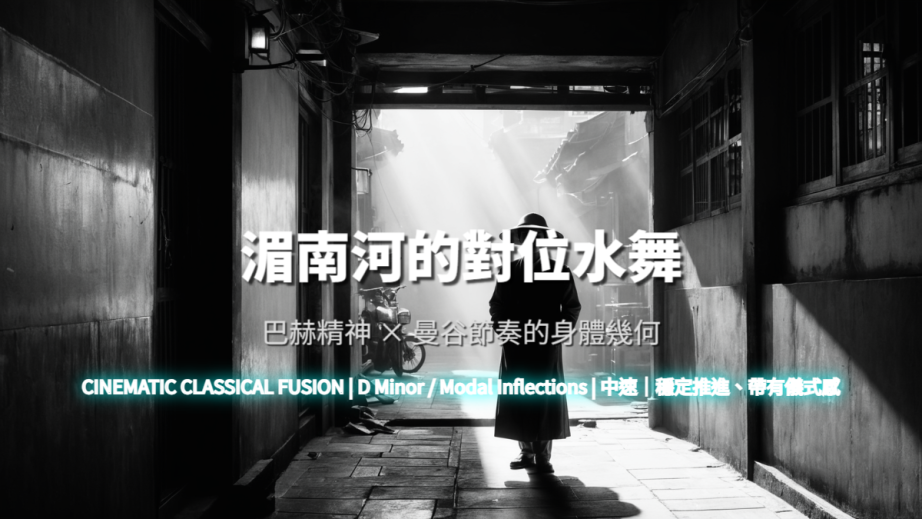
湄南河的對位水舞
巴赫精神 × 曼谷節奏的身體幾何
Context
Context
本曲定位為「儀式感強烈的古典融合電影音樂」,強調清晰節拍、空間層次與文化節奏的並置,而非模糊混合。
大提琴需以乾淨無顫音的斷奏與連弓交替呈現;Ranat Ek 負責高頻節奏骨架;Taphon 與 Gong Circle 提供循環脈動;低音弦樂僅在高潮段落加強根音重量。
Atmospheric texture only(無歌詞人聲,僅低聲吟唱質感)。
Intro(河流生成)→ Development(對位展開)→ Ritual Climax(舞蹈節奏最密集)→ Contemplative Release(回歸單一聲部)→ Ending(正式終止,全體齊奏)。
* 使用「counterpoint layering」避免旋律互相遮蔽。
* 打擊樂分頻處理,確保不壓縮大提琴中頻。
* 在 4–5 分鐘處引入節奏變形以避免早停。
* 利用「ritual tempo hold」維持儀式感。
* 結尾明確指定 no fade out。
* Counterpoint – 聲部獨立又互相呼應
* Ritual Percussion – 儀式型打擊循環
* Modal Strings – 非功能性調式弦樂
* Spatial Ensemble – 明確左右聲像配置
* Formal Ending – 正式終止結構
* J.S. Bach Cello Suites counterpoint analysis
* Thai Piphat ensemble rhythmic structures
* Classical Thai dance movement geometry
* Cross-cultural classical fusion music
(The soundscape begins in near silence, imagining the slow movement of water at dawn. A single cello line enters alone, each note clearly separated, with the bow gently contacting the string, establishing a sense of measured flow and intentional restraint.)
[Development][Counterpoint Formation][Structural Expansion]
(Additional implied voices are suggested through rhythmic accents and register shifts. The cello outlines harmonic pillars while invisible lines are felt rather than heard, evoking Bach-style counterpoint through implication.)
[Middle Section][Ritual Percussion Entry][Cultural Dialogue]
(Traditional percussion textures emerge one by one, each with precise timing. The mallet instruments articulate repeating figures, the drums reinforce cyclical motion, and the ensemble breathes together like a choreographed body.)
[Climax][Dance Geometry][Maximum Density]
(All elements align in tightly interlocked patterns. Rhythms become more complex yet remain controlled. The sensation is of watching a classical dance where every movement is predetermined yet alive.)
[Release][Reflection][Textural Reduction]
(Layers gradually withdraw, leaving space between gestures. The cello returns to prominence, now carrying the memory of the full ensemble within its phrasing.)
[Ending][Final Cadence][No Fade Out]
(The full ensemble reconvenes for a final, clearly articulated cadence. All motion resolves simultaneously, holding the final resonance in silence, marking a complete and formal conclusion.)
