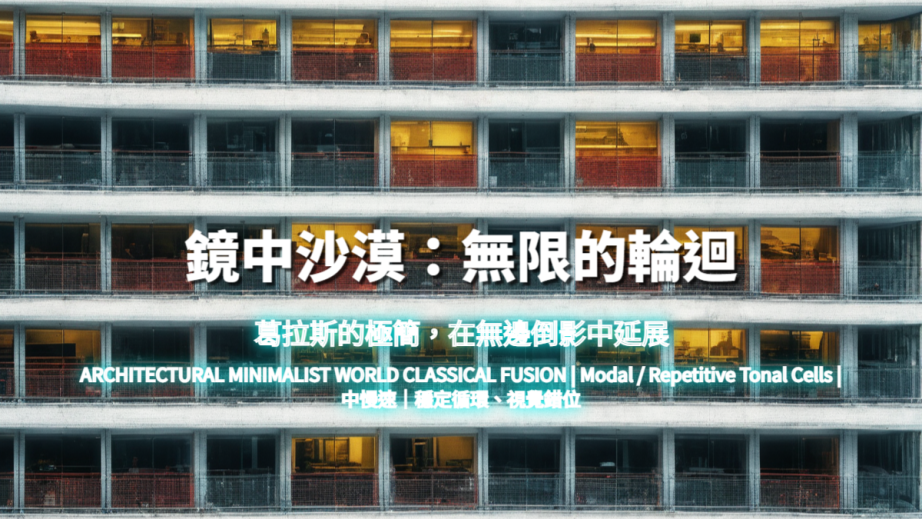
鏡中沙漠:無限的輪迴
葛拉斯的極簡,在無邊倒影中延展
Context
Context
在這座完全由鏡面構成的建築中,馬友友的大提琴不再只是聲音來源,而成為空間觸發器。每一次重複的音型,都在視覺與聽覺中被無限延展,形成一種無法分辨起點與終點的感知狀態。沙烏地傳統民謠中單調而持續的節奏,被轉譯為現代大提琴的循環語彙,象徵一個文化如何在保留核心節奏的同時,邁向未來。
《鏡中沙漠:無限的輪迴》並非關於速度或進步,而是關於方向感的消失與重建——正如 Vision 2030 所代表的,不是否定傳統,而是讓傳統在新的結構中被重新觀看。
風格定位為「建築導向的極簡主義聲響裝置」,以重複、相位錯位與空間反射作為主要結構。
大提琴使用短弓重複音型、微小音高變化與節奏相位偏移;低頻 Drone 提供沙漠穩定感;手拍或指擊模擬傳統節奏輪廓;完全依賴建築殘響塑造層次。
None(純器樂,文化元素以節奏結構呈現)。
Intro(第一道倒影)→ Loop Establishment(循環建立)→ Phase Reflection(相位反射)→ Desert Pulse Memory(傳統節奏記憶)→ Infinite Mirror Field(無限鏡像場)→ Ending(循環中斷,正式終止)。
* 指定 minimalist loop with phase shift,避免旋律敘事。
* 大提琴描述為 spatial trigger,而非情感主體。
* 使用 architectural reverb dominance,降低乾音比例。
* 節奏保持穩定,變化僅來自相位偏移。
* 動態控制在中等,讓重複產生催眠效果。
* 結尾指定 sudden reflective stop,避免自然淡出。
* Minimalist Loop – 極簡循環
* Phase Reflection – 相位反射
* Architectural Sound – 建築聲響
* Desert Futurism – 沙漠未來感
* Formal Ending – 明確結構終止
* Philip Glass minimalist phase techniques
* Maraya Concert Hall architectural acoustics
* Saudi traditional folk rhythm structures
* Vision 2030 cultural transformation
(The composition begins with a single repeating cello figure, neutral and steady, establishing the reflective environment.)
[Section I][Loop Establishment]
(The loop continues unchanged. The listener begins to sense repetition as space rather than motion.)
[Section II][Phase Reflection]
(Subtle timing shifts occur between repetitions, creating gentle disorientation and depth.)
[Section III][Desert Pulse Memory]
(Low pulses emerge beneath the loop, evoking traditional rhythmic persistence without melody.)
[Section IV][Infinite Mirror Field]
(The texture feels suspended, with sound and reflection indistinguishable, creating a hypnotic plateau.)
[Ending][Final Cadence][No Fade Out]
(All sound stops abruptly and together, breaking the illusion of infinity and marking a formal, intentional ending.)
