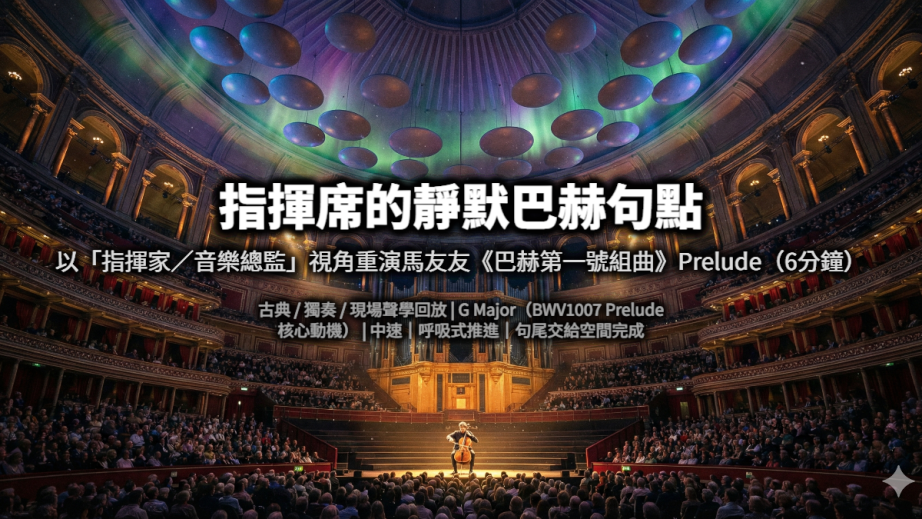
古典 / 獨奏 / 現場聲學回放
指揮席的靜默:威格摩的巴赫句點
以「指揮家/音樂總監」視角重演馬友友《巴赫第一號組曲》Prelude(6分鐘)
Lang: zh-TW
Mode: Instrumental
Audio Tracks
Creative Concept
這個版本刻意改用「指揮家/音樂總監」視角,因為在威格摩音樂廳(Wigmore Hall),真正需要被指揮的,往往不是樂團,而是:靜默、空間、觀眾的呼吸、以及回聲的落點。延續我們在上海音樂廳的巴赫《第一號無伴奏大提琴組曲》Prelude,樂譜不變、演奏者仍是馬友友,但威格摩的聲學讓每一個音符的命運改變:研究描述它的典型聲音是「響亮、寬闊、回響卻清晰」,滿座時中頻殘響約1.5秒,座席為全包覆軟椅,並有地毯等吸收元素,卻仍保有充足的回響與透明度——這種矛盾正是它的魔法。作為指揮/總監,我的工作是把這種透明度轉化為敘事:讓弓毛顆粒與換把聲成為「標點」,讓早期反射成為「第二次發聲」,讓句尾的提前放開把殘響交給空間,最後用一個不可妥協的「正式終止」收束全曲。虛擬導師設定為坂本龍一式的結構觀:把留白視為音符,把控制視為情感,把六分鐘雕刻成「一段完整的語法」。
Production Specs
WP_Production_Specs: 【風格總則】
高寫真現場獨奏回放;音場定位靠前、親密、可觸摸,保留木質共鳴與細微噪訊(但必須高級、克制、可控)。混響設計以室內樂廳尺度:清楚早期反射+溫暖中頻尾韻,絕不糊化,不用電影式拖尾。動態以微差為王:pp仍有密度與核心,mf是「語氣加重」而非音量炫耀。總體情緒走向:由端正靜默進入穩定推進,轉入內省透明,再以形式感句點落下。
WP_instructions: 【樂器】
-
指揮/總監(舞台控制):負責「靜默管理」與「回聲落點」;在每個段落轉折處,規劃微停頓長度與觀眾呼吸的容許範圍
-
馬友友(大提琴):起音清楚但不硬;句尾提早放開,讓殘響完成連線;揉弦極節制(語言式而非歌唱式)
-
右手弓法:以弓速塑形、以壓力收斂;重點在顆粒可聽、核心穩定、邊緣圓潤
-
左手語法:換把不可粗暴消失,也不可放任;要被控制成「逗點、分號、句點」
-
空間聲學:前場清晰、尾韻溫暖;避免任何「朦朧化」處理,保留清澈細節
WP_vocals: 【人聲】
None(僅保留極低存在感的廳內空氣底噪;不得形成可辨識旋律或語句)
WP_structure: 【結構與時間設計】
00:00–00:22 指揮的第一拍:靜默(觀眾呼吸變成拍點)
00:22–01:35 主動機建立:清楚起音+句尾放開,讓空間完成連線
01:35–03:05 密度推進:以微停頓作標點,避免機械化流水
03:05–04:25 內省段:動態下探到pp但保留核心密度,讓透明度成為情感
04:25–05:25 回歸與微變奏:同一材料換一種「更像說話」的重音配置
05:25–06:00 終止:長延音+集體停頓+真實停止,不淡出
WP_SUNO_Tech: 【SUNO 高級技巧教學】
-
把「指揮視角」寫進段落標籤:例如在每段括號內加入“conductor cue: hush / hold / release”,模型更容易生成有呼吸的時間感
-
在Style明確要求“clear early reflections + warm mid tail + no smear”,並在段落中重複“release early at phrase ends”,可顯著降低糊尾與過度連音
-
用“micro-pauses as punctuation”描述密度段(01:35–03:05),避免模型把分解和弦變成無語氣的連續機械流
-
若生成太浪漫,加入“minimal vibrato, speech-like articulation, no theatrical swell”,將情緒拉回結構與透明度
-
若生成太乾,加入“intimate chamber hall, supportive mid-band tail ~1.5s feel, warm wood response”,補回威格摩式的親密回響
-
結尾一定要寫“grand fermata + silence + stop”並加“No Fade Out”,否則容易被自動延長或淡出
-
在Intro加入“pre-note silence as downbeat”可避免模型第一拍太急,並建立指揮席的時間權威
WP_SUNO_Tag: 【本曲必學的 SUNO 高級標籤】
[Intro][Conductor Downbeat Silence] – 把靜默當第一拍,建立威格摩的親密張力[Early Reflections][Immediacy] – 用早期反射做「第二次發聲」,增加貼耳感[Phrase Punctuation][Micro-Pauses] – 以微停頓作標點,讓分解和弦像語言[Warm Mid Tail][No Smear] – 有尾韻但不糊,維持清澈透明[PP With Core] – pp仍有密度與中心,呈現真實近距離[Grand Fermata][Silence Hold] – 結尾用停頓完成形式感句點[No Fade Out] – 嚴禁淡出,必須正式終止
Technical Data
06:00
中速|呼吸式推進|句尾交給空間完成
G Major(BWV1007 Prelude 核心動機)
大提琴(獨奏), 音樂廳自然殘響(空間作為第二聲部)
高端耳機鑑聽、音樂廳聲學比較、舞台導演式聆聽、古典錄音參考
Social (Short)
Social (Long)
延續上海音樂廳那首巴赫《第一號無伴奏大提琴組曲》Prelude,我知道觀眾心裡早已有一份記憶:上海的回聲更像歷史的帷幕,音符被托起、被環抱,呼吸被拉長。但威格摩不同。研究形容它的典型聲音是「響亮、寬闊、回響卻清晰」,而滿座時中頻殘響大約在1.5秒左右——聽起來像是剛好能把線連起來的長度,卻又短到足以揭露每一次弓毛顆粒、每一次換把的摩擦、每一次指腹壓弦的細微改變。這意味著:你不能把句子丟給殘響去「自動修飾」,你必須自己說清楚,然後把尾韻交給空間完成,而不是讓空間替你掩護。
所以,我的第一個指揮手勢不是“開始”,而是“靜”。我需要觀眾的呼吸先落下去,讓空氣密度變得一致。這不是儀式感的表演,而是聲學上的必要:當廳內仍有零碎聲響,威格摩的清晰度會把它們像細沙一樣灑進音樂裡;當全場真正安靜,音樂才會像一束光從黑暗裡升起。接著,我會在馬友友第一個音前給出一個極小的、幾乎看不見的“準備拍”,讓他把弓毛對準弦面,讓起音既清楚又不硬。
在這座廳裡,句尾是最需要被指揮的地方。上海的記憶會誘惑演奏者把弓拖得更長、把尾韻唱得更滿,因為大廳會回敬你一片漂亮的雲。但在威格摩,拖尾會變成黏連,漂亮會變成過度。真正高級的做法反而是「提早放開」:在樂句該結束的瞬間就把弓鬆開一點點,讓殘響自然接上去。那一瞬間,空間像第二聲部一樣把句子補完——觀眾會以為是連音,實際上是你對回聲的信任。
密度段落更殘酷。Prelude 的分解和弦很容易被拉成無呼吸的流水,尤其在六分鐘的回放裡更危險:如果沒有標點,觀眾只會聽到忙碌,而不是語言。因此我會用指揮的眼神與微小停頓去“刻字”:每到和聲轉折,我要求一個極短的吸氣空白,像逗點、像分號。馬友友不是靠放大力度,而是靠讓每一次重音像說話的加重——不是吼,而是清楚。
最讓我著迷的是內省段。威格摩的pp不是小聲,而是近。當馬友友把動態下探到pp,音色仍然有核心密度,觀眾甚至會覺得音更大,因為它更貼近、更直接。那時候,指揮的角色是守住秩序:不讓情緒溢出、不讓速度漂移、不讓任何“想更漂亮”的念頭干擾透明度。最後的終止必須像正式句點:一個長延音、一個全場共同的停頓,然後真實停止——不淡出,不偷懶。因為在威格摩,留白不是結束後的附贈,而是結束本身。當最後的回聲落下,我仍會保持手勢不動,讓那幾秒的靜默完成最後一個小節。等到空氣真的歸零,我才會把手放下,交還掌聲。這就是威格摩的巴赫:不是更大,而是更真;不是更炫,而是更清楚。
Lyrics & Structure
Wigmore Conductor’s Silence 指揮席的靜默
[Opening Flow][Early Reflections][Immediacy](As arpeggios unfold, the conductor listens for the hall’s second voice: crisp early reflections that add presence and clarity. The instruction is to let the room complete legato—release note tails slightly early so the space stitches lines together without smearing. The pulse stays steady, but phrasing breathes; each harmonic cell ends with a subtle relaxation that reads like punctuation rather than interruption.)
[Phrase Grammar][Micro-Pauses as Punctuation](At each harmonic turn, the conductor “writes commas” into time: micro-pauses that are felt more than heard. These tiny gaps prevent mechanical continuity and turn the arpeggios into spoken sentences. The dynamic remains contained—mf is articulation and intent, not projection. The hall tail supports continuity, but the performance never leans on reverb as decoration; clarity remains the primary aesthetic.)
[Development][Density Control][No Smear](As texture thickens, the conductor’s role is restraint: insist on precision, maintain steady tempo, and keep articulation crisp. Bow speed increases slightly while pressure decreases, preserving brightness without aggression. Left-hand shifts are controlled and purposeful, audible as syntax, not slips. The hall remains “spacious yet clear”; the reverb tail is present but disciplined, always secondary to the direct sound.)
[Midpoint Pivot][Internalization][PP With Core](The conductor signals an inward turn: dynamics drop toward pp, but tone must not thin. The instruction is “quiet with body”—a dense core that still reaches the back of the room because the hall is intimate, not because the player forces volume. The cello’s wood resonance becomes the emotional carrier, and the space becomes a soft frame rather than an effect. Breaths are synchronized with phrase endings; silence becomes a measured material.)
[Transparency Passage][Speech-Like Articulation](Here the conductor asks for minimal vibrato and maximum honesty: let the line speak rather than sing. Keep the overtone shimmer natural, never glossy. Allow tasteful performer details—finger pressure changes, controlled string contact—to appear as a refined realism. Maintain strict no-smear clarity: reverb supports, but the listener always hears the start and end of each note as a deliberate choice.)
[Return][Motif Re-Illumination][Subtle Re-Weighting](The opening material returns, but the conductor requests new emphasis: slightly different weighting on downbeats, lighter upbeats, and earlier releases at the ends of cells so the hall can bloom. The arc is not louder; it is clearer. The feeling is of the same sentence spoken with new understanding, with the room’s early reflections adding immediacy and the mid-band tail providing gentle continuity.)
[Final Gathering][Controlled Crescendo][Formal Direction](Energy gathers for a final statement, but the conductor forbids theatrical swell. Crescendos are brief and precise, like spoken stress on key words. The tempo remains steady; micro-pauses remain at harmonic corners. The hall’s warmth is felt in the tail, yet articulation stays intact. The cello’s low-mid core is unwavering, ensuring that even stronger moments remain refined and centered.)
[Ending][Final Cadence][No Fade Out](The conductor prepares the decisive closure: cue a clean articulation into the final harmonic arrival, then hold a grand fermata where the last resonance is allowed to live fully. After the sound decays, maintain a shared stillness for several seconds—silence as the final bar—then release the room with a gentle, definitive drop of the hands. The performance stops completely, with no fade, no continuation, only a formal, finished period to the musical sentence.)
References
-
Wulfrank & Orlowski, “Acoustic Analysis of Wigmore Hall, London, in the Context of the 2004 Refurbishment” (PDF;提及典型聲音描述與滿座中頻殘響約1.5s、座席與材質) https://kahleacoustics.com/articles/Wulfrank_Wigmore_Hall_2006.pdf
-
Wigmore Hall 官方 About Us(intimacy / crystalline acoustic、座位容量資訊)https://www.wigmore-hall.org.uk/about-us
-
Wikipedia:Wigmore Hall(設計、翻新、容量資訊)https://en.wikipedia.org/wiki/Wigmore_Hall
-
Wigmore Hall 官方 History(建築定位:grand and intimate、早期評論)https://www.wigmore-hall.org.uk/about-us/history
